
Faire dialoguer les recherches acquisitionnelles et les pratiques d’enseignement des langues.
Coordinators: Gema Sanz Espinar and Sladjana Djordjevic
The working group " Interface Acquisition / Didactics of foreign languages " is interested in the specificities of guided language teaching/learning in different situations and educational contexts (foreign living language, bilingual section, first-come, study abroad, specialty languages, heritage languages ...) and their effects on the acquisition of the target language (LC) from various audiences (children, adolescents, adults).
Research in Second Language Acquisition/foreign (RALE/2) and Foreign Language Culture Didactics (DILCE) are two close areas that are interested in foreign language acquisition/appropriation processes. On the one hand, RALE/2 aims to reveal the elements of various kinds – linguistic, cognitive, discursive – that explain the acquisitional processes in order to understand the mechanisms and factors involved in the appropriation of one or more languages, whether they are first, second or foreign. On the other hand, DILCE research is covered by the praxis and aim to better understand classroom practices, their influence on language learning in learners and aim at in fine to improve second/foreign language teaching/learning. As regards the work at the interface of RALE/2 and DILCE, they have emerged in France in recent years (see e.g. Pallotti 2002, 2017; Véronique 2005, 2009; Trevisiol-Okamura & Kour-Thilloy 2011; Hilton 2012; Laurens & Véronique 2017, Watorek & al. 2017; Alazard-Guiu, Santiago & Mairano 2018), but still lack visibility The dialogue between the two disciplines is still under construction and requires further development.
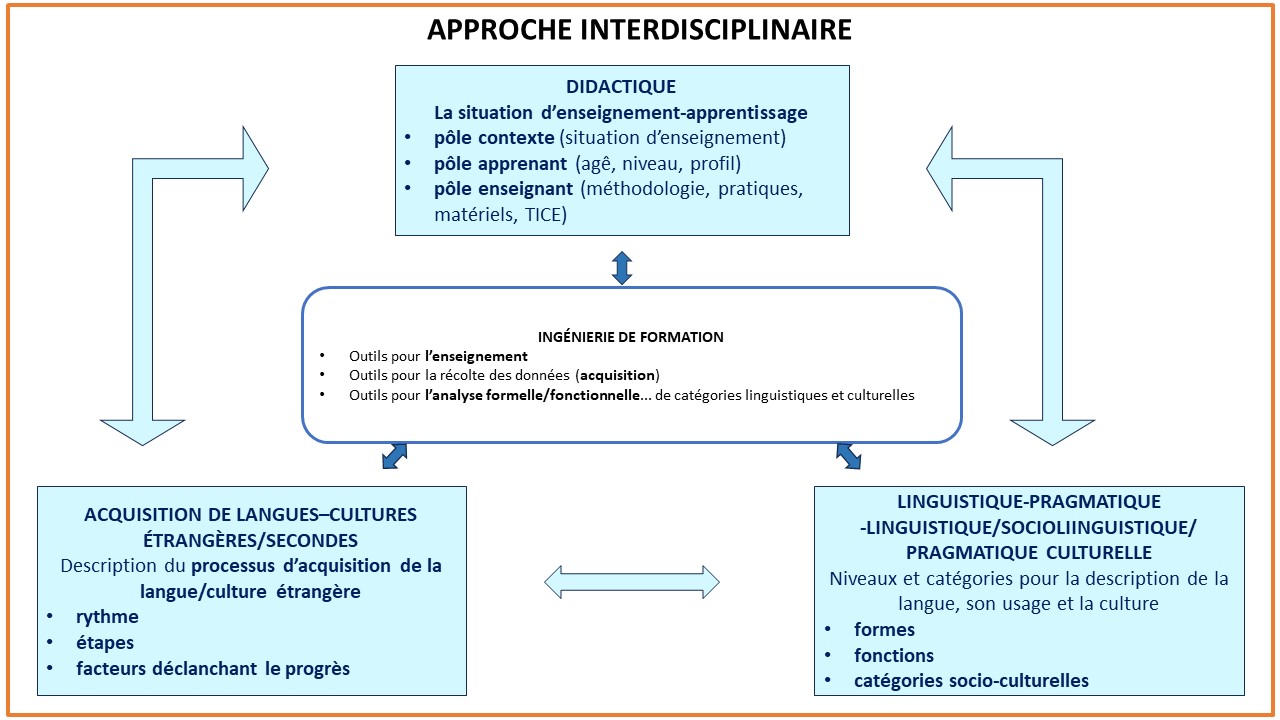
The objective of the working group " Foreign Language Acquisition/Didactics Interface " is to better understand the acquisition processes in guided teaching situations; contribute to the improvement of language teaching/learning systems and the initial and/or continuing training of teachers; to reflect on the linguistic description adapted to the context (vs The reference language) of the subject to be taught (LC) in an interdisciplinary approach (cf fig.1); The results of this research are widely disseminated and transferred.
Our central study will therefore be the acquisition in a guided environment and the phases of this process (fig.2) in different teaching/learning situations.
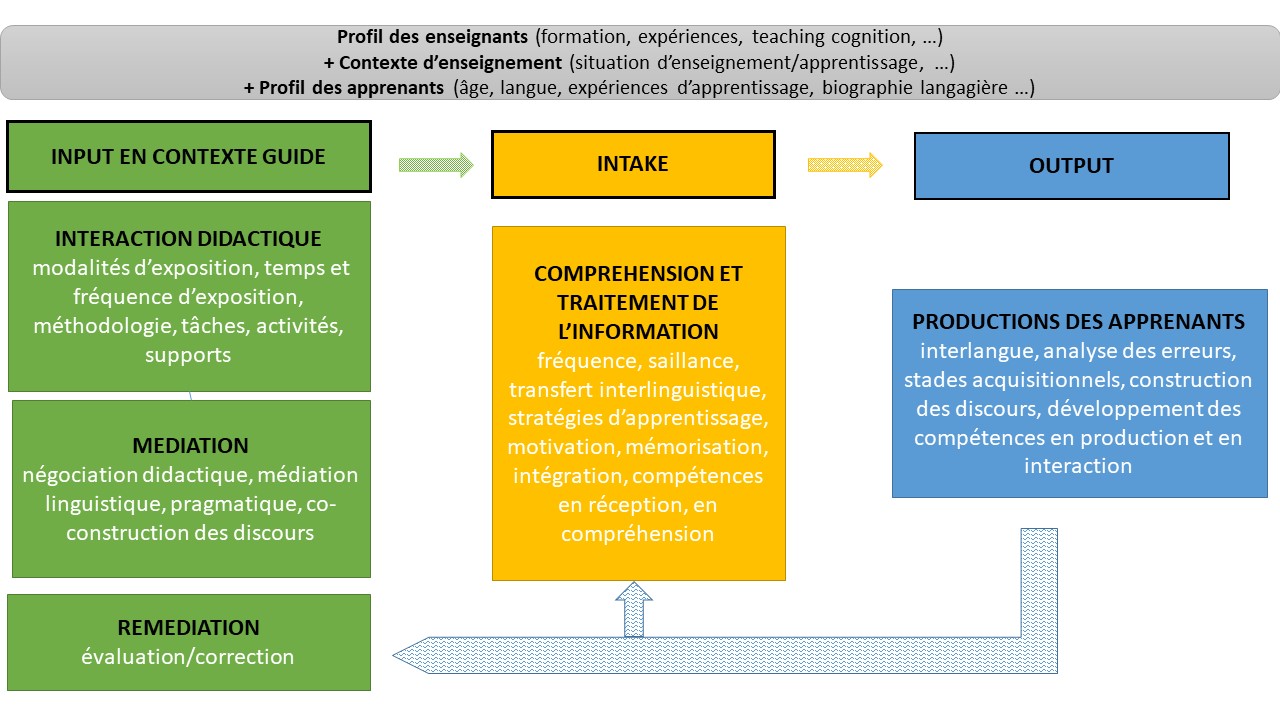
In guided context, learners are exposed to a input mediated by interaction with the teacher and peers as well as by the teaching system whose characteristics are specific to each learning situation. From a cognitive point of view, the acquisition process is understood as data processing (intake) to which the learner is exposed in order to appropriate them and integrate them into his long-term memory and thus develop communicative skills in L2/LE. The study of the productions (output) of learners informs about their interlanguages and their acquisitional paths. This output is often the subject of feedback for positive reinforcement or remediation, which in turn will be a part of theinput offered to learners in a circular dynamic.
The group " Foreign Language Acquisition / Didactics Interface » generally seeks:
- to make the natural relationship between the learning process (at the learner) and teaching practice more visible in order to enrich the thoughtful practice (at the teachers) and the consciousness of the teaching-learning process (context, situation, participants, materials, methodologies...) and vice versa;
- to establish links between the RALE/2 concerning acquisition and its description or evaluation and research in DILCE concerning the different ways of teaching the language (teacher's centre) or learning (learner's centre);
- to propose didactic transpositions of the results of studies conducted in RALE/2, exploitation and didactic effects of RALE/2 results and, conversely, to consider the contributions of the work carried out in DILCE on research in language acquisition.
- to find ways to contribute to the training of teachers and future teachers in an interdisciplinarity Acquisition-Didactics.
To join this group, find out the list of members, explore the list of past activities, read about upcoming activities, you must subscribe to the mailing list: